SIU Neurology Resident Neuroscience Course
Chapter 17. The Anatomical Organization of the Central Nervous System
-
The substantia nigra is part of the:
-
Medulla
-
Pons
-
Midbrain
-
Diencephalon
-
The suprachiasmatic nucleus, part of the hypothalmus, is involved in
-
Feeding behavior
-
Circadian rhythms
-
Growth
-
Maternal behavior
-
Cells in primary visual cortex are responsive to highly complex information,
such as the shape of a face.
-
True
-
False
-
Human beings have more cortical information-processing ability than rhesus
monkeys primarily because
-
Human cerebral cortex is thicker
-
Human pyramidal neurons are more functional
-
Humans have more cortical columns (modules)
-
Humans have more white matter
-
The insular cortex is closest to the
-
Opercular cortex
-
Cingulate cortex
-
Uncus
-
Calcarine sulcus
-
Cerebral neocortex has how many layers?
-
Three
-
Five
-
Six
-
Seven
-
Thalamic inputs to neocortex primarily end in which cortical layer?
-
Layer II
-
Layer IV
-
Layer V
-
Layer VII
-
Large pyramidal cells in motor cortex projecting to spinal cord are found
in which layer?
-
Layer II
-
Layer IV
-
Layer V
-
Layer VI
-
Basket cells use which of these neurotransmitters?
-
GABA
-
Glutamate
-
ACh
-
Norepinephrine
-
This distinctive six-layered structure is called the
a. Inferior colliculus
b. Amygdala
c. Lateral lemniscus
d. Hippocampus |
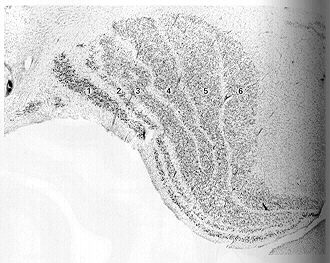 |
Chapter 18. The Functional Organization of Perception and Movement
-
How many pairs of spinal nerve roots are there in humans?
-
Eight
-
Twenty-five
-
Thirty
-
Thirty-one
-
Somesthetic fibers from the body synapse in the
-
Ventral posterolateral nucleus
-
Ventral posteromedial nucleus
-
Medial lemniscus
-
Medial dorsal nucleus
-
The medial geniculate body is concerned with
-
Vision
-
Touch
-
Hearing
-
It shows no concern
-
Subcortical structures projecting to the cerebral cortex project first
to thalamus, then to cortex, with the exception of
-
Dentate nucleus
-
Emboliform nucleus
-
Globus pallidus
-
Olfactory bulb
-
The primary sensory cortex contains not just one, but four complete
topographic maps of the skin surface
-
True
-
False
-
Multimodal association cortex is primarily concerned with
-
Relaying information
-
Fine discriminatory sensations
-
Production of a unified percept
-
There is no good hypothesis for its function at present
-
The human corticospinal tract contains approximately
-
Ten thousand axons
-
One million axons
-
One billion axons
-
One jillion axons
-
The human corticospinal tract (answer like an anatomist)
-
Decussates in the medulla
-
Decussates near the ventral horn cells it innervates
-
Both
-
The human corticospinal tract (answer like a clinical neurologist)
-
Decussates in the medulla
-
Decussates near the ventral horn cells it innervates
-
Both
-
The corticospinal tract is particularly important for
-
Individuated finger movements
-
Walking
-
Grasping
-
Chorea
This is a take-home test due 11/20/01
A score of 80% or better is required.