SIU Neurology Resident Neuroscience Course
Chapter 39. The Control of Gaze
-
The near response consists of
-
Accomodation and pupillary constriction
-
Vergence, accomodation and pupillary constriction
-
Retinal disparity, vergence, accomodation and pupillary constriction
-
Paradoxical accomodation
-
The movement illustrated is an example of
-
Intorsion
-
Extorsion
-
Elevation
-
Depression
|
 |
-
With the eye in an adducted position, elevation is primarily the responsibility
of the
-
Superior rectus
-
Inferior rectus
-
Superior oblique
-
Inferior oblique
-
A skew deviation and a head tilt to the right may indicate a lesion affecting
the
-
Oculomotor nerve
-
Abducens nerve
-
Trochlear nerve
-
Optic ganglion
-
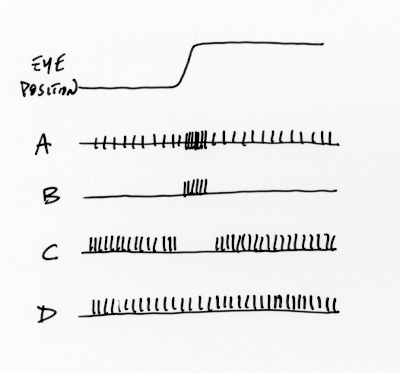
This is a diagram of neuronal firing patterns during a horizontal saccade.
Match the firing pattern with the most likely anatomic location of the
neuron (4 points).
-
PPRF
-
Nucleus prepositus hypoglossi
-
Nucleus of the dorsal raphe
-
Abducens nucleus
|
 |
-
Which of the following is not involved in horizontal saccadic eye movments?
-
Frontal eye fields
-
Substantia nigra
-
Superior colliculus
-
Dentate nucleus
This is an open-book test due 3/5/2002
A score of 80% or better is required. If your score is less, you
are required to retake the test.
Back to neuroscience page