Chapter 8.  Passive Membrane Properties

  1. Which of these neuronal properties is not a "passive membrane property"?

  2. a. Resting membrane potential
    b. Input resistance
    c. Membrane capacitance
    d. Intracellular axial resistance
  3. The passive membrane properties of an unmyelinated axon can be modelled well by simple resistors and capacitors.

  4. a. True
    b. False
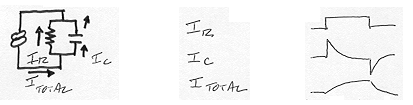
  5. Consider this circuit, to which a constant current stimulus is applied.  Match the currents illustrated to the proper circuit elements. (Draw a line from the current symbol to the current tracing.
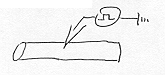
  6. Consider this diagram. Which of these passive membrane properties affects how fast current will spread from the electrode connected to the current generator.
    a. Input resistance
    b. Membrane capacitance
    c. Axial resistance
    d. All of the above
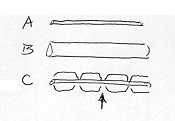
  7. Which of these axons will conduct the slowest?
    a. Small unmyelinated
    b. Large unmyelinated
    c. Small myelinated
  8. The arrow in the diagram above points to

  9. a. A calyx of Held
    b. A node of Ranvier
    c. A node of Saltere
    d. A t tubule
Chapter 9.  The Action Potential

  1. Which of the following names are not noted for their work in elucidating the basis of the action potential?

  2. a. Kenneth Cole
    b. Alan Hodgkin
    c. Andrew Huxley
    d. Eric Kandel
  3. At the node of Ranvier, which of these channels or channel properties is not much responsible for action potential repolarization?

  4. a. Voltage-sensitive sodium channel inactivation
    b. Voltage-sensitive potassium channel activation
    c. Leak channels
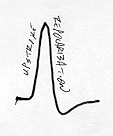
  5. Match the action potential characteristic to the channel characteristic(s) most responsible for it by drawing one or more lines to connect the action potential to the channel characteristic.

  6.  
    Upstroke


    Repolarization

    Delayed rectifier activation

    Delayed rectifer inactivation

    Na+ channel activation

    Na+ channel inactivation

  7. Tetrodotoxin can be used to block voltage-sensitive sodium channels.

  8. a. True
    b. False
  9. Which of the following is not the name of an ion channel?

  10. a. A type channel
    b. Inward rectifier channel
    c. Fugu channel
    d. Calcium-activated potassium channel
  11. Voltage-sensitive sodium and calcium channel alpha subunits are constructed from a single polypeptide chain with four domains.

  12. a. True
    b. False
  13. Which of the following are not important for normal voltage-sensitive sodium channel function?

  14. a. S4 region
    b. tethered plug
    c. P loop
    d. Magnesium
This is a take-home test due 10/9/01
A score of 80% or better is required.